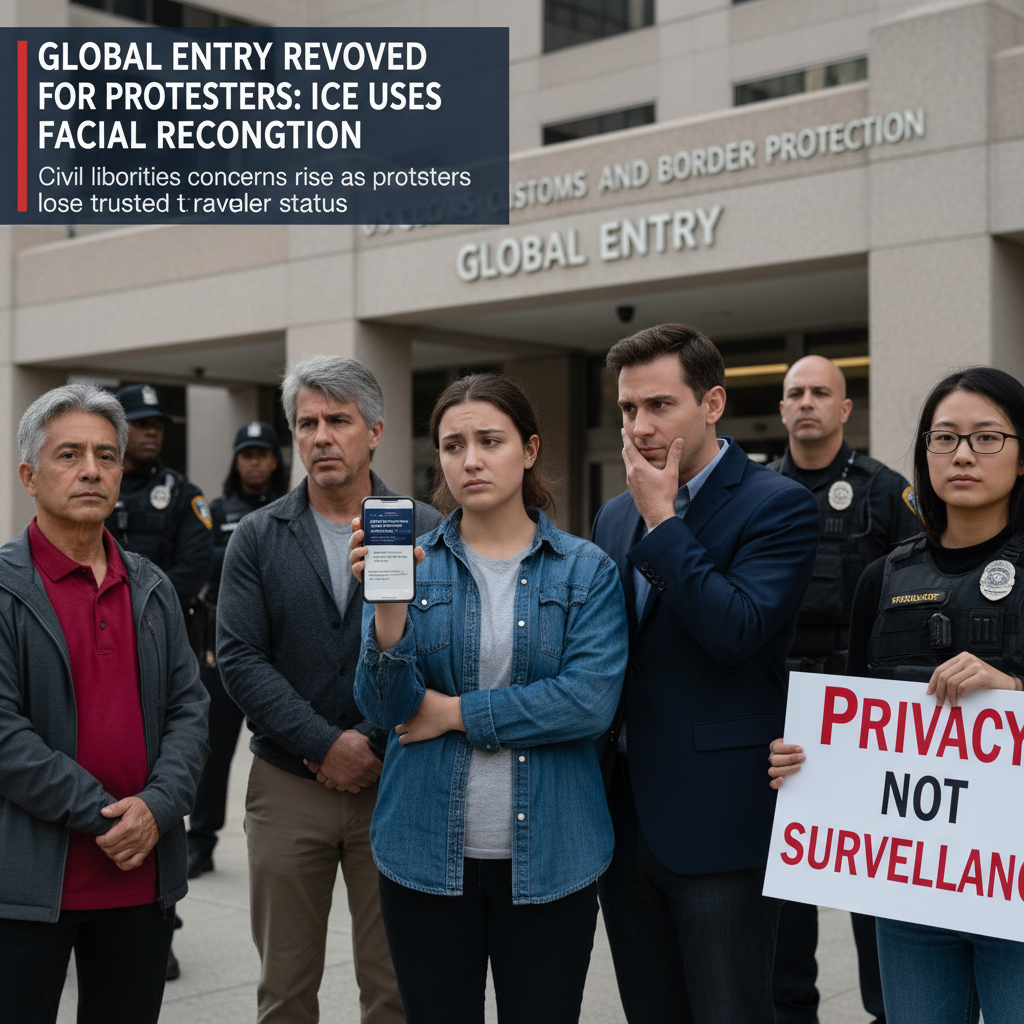
Recent reports from multiple reputable news outlets indicate a concerning development for participants in public demonstrations: U.S. Immigration and Customs Enforcement (ICE) agents are reportedly utilizing facial recognition technology to identify protesters, subsequently leading to the revocation of their Global Entry memberships. This practice, initially highlighted by various media reports [1], has raised significant questions about privacy, civil liberties, and the scope of government surveillance.
The Alarming Development
Global Entry, a program designed to expedite international travelers through U.S. customs, offers a significant convenience to its members, allowing for faster processing at airports and borders. However, membership is conditional, requiring applicants to pass a thorough background check and maintain good standing. The revelation that participation in protests can now lead to the loss of this privilege, specifically through the deployment of advanced surveillance technology, marks a new frontier in the interaction between government agencies and public dissent.
How Facial Recognition is Being Used
According to the reports, ICE agents are reportedly sifting through publicly available images and videos from protests, employing facial recognition algorithms to match individuals with existing government databases, including those related to travel documents. Once an identity is confirmed, and if an individual is deemed to have engaged in activities that violate the terms of their Global Entry membership (often broadly defined as criminal activity or actions that raise security concerns), their membership can be unilaterally revoked by U.S. Customs and Border Protection (CBP), the agency overseeing the program and part of the Department of Homeland Security (DHS), alongside ICE.
Implications for Travelers and Civil Liberties
The immediate consequence for affected individuals is the loss of expedited processing at airports and borders, reverting them to standard customs queues. More broadly, this development sends a chilling message to prospective protesters, potentially deterring participation in lawful assembly due to fears of government surveillance and punitive measures impacting their travel privileges. Critics argue this infringes upon First Amendment rights to free speech and assembly, creating a "watch list" for dissent that extends beyond traditional security threats. It also intensifies concerns about the accuracy and potential bias of facial recognition technology, and the lack of transparency and due process in such revocations.
Calls for Scrutiny
As this practice comes to light, there are growing calls from civil rights organizations, legal experts, and lawmakers for greater transparency regarding the policies and procedures governing the use of facial recognition technology by federal agencies, particularly when it intersects with constitutional rights. The incident underscores the ongoing tension between national security interests and the protection of individual freedoms in the digital age.
Planning Your Next Adventure? Find Unbeatable Deals!
Don't let travel complexities deter you from exploring the world! Whether you're planning a quick getaway or an extended international journey, finding the best flight and hotel deals can significantly enhance your experience and budget.
Leverage our powerful search tool to compare prices from hundreds of airlines and hotels worldwide. Find exclusive offers, save money, and book your perfect trip with ease.
Discover Unbeatable Deals at bestflighthoteldeals.com!